Video about one girl speaking H’Mong language for her story.
Discovering Vietnam’s Diverse Languages and Communication Cultures
Vietnam is not only renowned for its picturesque landscapes but also for its vibrant tapestry of languages and communication cultures. Beyond the familiar Vietnamese language, this S-shaped nation is home to dozens of ethnic groups, each with their own distinct languages and unique communication styles, painting a truly lively social picture.
SPECIAL OUTLINE
I. Ethnic Minority Languages: A Kaleidoscope of Voices: Dive deep into the diversity of ethnic minority language groups in Vietnam. Explore key language families such as Tai-Kadai, Mon-Khmer, Hmong-Mien, Malayo-Polynesian, and Sinitic. Discover the prominent features, geographical distribution, and the importance of language preservation for each ethnicity, along with how they overcome language barriers in social interactions.
II. Global Integration: The Imprint of Foreign Languages: Analyze the influence of English – the global lingua franca – in Vietnam’s education, business, and international integration. Additionally, revisit the historical and current roles of French, Russian, and Chinese, and how foreign words have been adopted, localized, and enriched the Vietnamese vocabulary.
III. “Speaking” Without Words: The Power of Non-Verbal Communication: Explore forms of communication that don’t involve spoken words, yet are profoundly significant in Vietnamese culture. Learn about body language (gestures, facial expressions, eye contact) and their deep cultural meanings. Analyze proxemics (personal space) and regional differences in communication distance. This section also covers the art of communicating through silence and other non-verbal cues.
IV. The Vietnamese Psyche Through Communication Styles: Delve into the characteristic features of Vietnamese communication culture. Understand the hierarchy and forms of address that reflect social status and respect. Unravel the “ý tứ” (subtlety), “ý nhị” (delicacy) culture, and why Vietnamese people often choose indirect expression. Furthermore, discover the role of proverbs, folk sayings, and folk songs in conveying messages subtly and profoundly within families, workplaces, and communities.
V. Bridging Understanding: Intercultural Communication: Discuss common challenges and misunderstandings that arise in intercultural communication within Vietnam. Propose ways to enhance intercultural communication skills, helping both Vietnamese people and international friends better understand each other, thereby building strong and effective relationships.
VIETNAM: A MELTING POT OF DIVERSE VOICES AND THE ART OF DEEP CONNECTION!
Now! Let’s discover the fascinating world of languages and communication in Vietnam.
I. Ethnic Minority Languages: A Kaleidoscope of Voices and Speaker Demographics
Vietnam proudly hosts 54 ethnic groups, each embodying a unique cultural identity vividly expressed through their language. Besides the familiar Vietnamese language of the Kinh majority (accounting for approximately 85.3% of the total population), we can highlight the main language families that contribute to this richness, along with estimated speaker populations (based on ethnic group populations from the 2019 Population and Housing Census):
Vietnam is home to 54 officially recognized ethnic groups, each possessing distinct linguistic traditions and unique cultural identities that collectively contribute to the nation’s rich tapestry of heritage.
Note: To discover Vietnam’s Ethnic Diversity, Please Click here!
Tai-Kadai Language Family: This is one of the largest and most influential language families in the mountainous northern regions of Vietnam. Prominent languages within this family include Tay (population around 1.8 million people), Nung (around 1.1 million people), Thai (around 1.8 million people, with groups like Black Thai, White Thai, Red Thai), and even Lao (around 17,500 people). Tai-Kadai languages are characterized by rich tonal systems, gentle intonations, and often share similar sentence structures with Vietnamese. They play a crucial role in preserving the folk culture, singing traditions, and storytelling of these ethnic groups.
Mon-Khmer Language Family (Austroasiatic): Distributed widely from the northern mountains (like Muong in Hoa Binh, Thanh Hoa) to the Central Highlands and even the Southern region.
Key languages include: Muong (population around 1.4 million people), particularly close to Vietnamese, considered a “sister” language with a common origin; Khmer (population around 1.3 million people), the language of the Khmer community in the Mekong Delta, bearing strong cultural marks of the ancient Angkor civilization; Central Highlands languages like Ba Na (around 287,000 people), Xo Dang (around 212,000 people), Gia Rai (around 513,000 people), Ede (around 398,000 people), M’Nong (around 127,000 people), Stieng (around 100,000 people); and other languages such as Kho Mu (around 90,000 people), Bru-Van Kieu (around 94,000 people).
Mon-Khmer languages often feature complex phoneme systems, many initial and final consonants, and sometimes distinct sentence structures compared to Vietnamese.
Hmong-Mien Language Family (Hmong-Mien/Sino-Tibetan): Comprising Hmong (Mông) (population around 1.4 million people) and Dao (Mèo) (around 891,000 people), primarily spoken by ethnic groups living in the high mountainous regions of Northern Vietnam. These languages are notable for their intricate tonal systems, which can have up to 8-12 tones, and unique grammatical features. They are often passed down orally through generations, closely linked to folk songs, customs, and indigenous knowledge of the Hmong and Dao people.
Malayo-Polynesian Language Family (Austronesian): The most prominent representative in Vietnam is Cham (population around 179,000 people), the language of the Cham ethnic group living mainly in the central provinces (Ninh Thuan, Binh Thuan) and partly in the South. Cham is an ancient language, tied to the glorious Champa civilization, with its own writing system and a rich literary heritage. Other ethnic groups in this language family include Gia Rai, Ede, Ra Glai, and Chu Ru.
Sinitic Language Family (Sino-Tibetan): Primarily consists of Chinese dialects (Cantonese, Hokkien, Teochew) spoken by the Hoa community (population around 823,000 people) living in major cities like Ho Chi Minh City, Hanoi, and some other regions. Chinese has also profoundly influenced Vietnamese over thousands of years of cultural exchange, most evident in the extensive Sino-Vietnamese vocabulary in modern Vietnamese. Other Sinitic languages include San Diu and Ngai.
Other Language Families: Vietnam also hosts ethnic groups belonging to smaller language families such as Kadai (La Chi, La Ha, Co Lao, Pu Peo languages) and Tibeto-Burman (Ha Nhi, Phu La, La Hu, Lo Lo, Cong, Si La languages). Although the number of speakers for these is smaller, they all contribute to the linguistic diversity of the nation.
Preserving and promoting ethnic minority languages is an extremely important task. It not only helps safeguard the unique cultural identity of each ethnic group but also provides a way for younger generations to access, learn, and develop their ancestral heritage. Bilingual education policies, research projects, and publication of materials in ethnic languages are actively contributing to this effort, ensuring that these “kaleidoscope of voices” continue to resonate throughout Vietnam.
However, when ethnic minorities are not fluent in standard Vietnamese or do not know each other’s languages, they still find ways to communicate to meet emerging social needs. This is primarily achieved through:
Non-verbal communication: Using gestures, facial expressions, eye contact, postures, and symbols (like traditional attire, exchanged goods) to convey messages.
The role of intermediaries: Bilingual or trilingual individuals within the community act as bridges not only for language but also for culture, facilitating translation and contextual explanation in transactions, administrative procedures, healthcare, or education.
“Trade” languages and observation: At highland markets or in economic exchanges, they often use hand gestures, simple signals, or learn through practical observation to bargain and exchange goods.
Community adaptation efforts and state support: Bilingual education programs, multilingual media, and the self-efforts of the people also help bridge the language gap.
NOTE: TO LEARN MORE ABOUT THE CIVILIZATION & DISTICT LANGUAGES IN VIETNAM, PLEASE CLICK HERE
II. Global Integration: The Imprint of Foreign Languages
The process of international exchange and integration has brought significant influences from global languages into Vietnamese life:
English: Undeniably, English is currently the most dominant language. From schools to offices, from tourism to trade, English has become a crucial bridge helping Vietnam integrate more deeply with the world. Many young people even use English words in daily communication such as “OK,” “online,” or “meeting.”
French: Once the primary language during the colonial period, French still leaves a strong mark in architecture, cuisine, and particularly in Vietnamese vocabulary (e.g., bơ (butter), cà phê (coffee), phô mai (cheese), ban công (balcony)).
Russian and Chinese: These also played specific roles during certain historical periods and within particular communities. Russian was common during the subsidy period, while Chinese has had a long-lasting influence through thousands of years of cultural exchange.
The adoption and Vietnamization of foreign words have enriched Vietnamese, making it more diverse, flexible, and responsive to global trends.
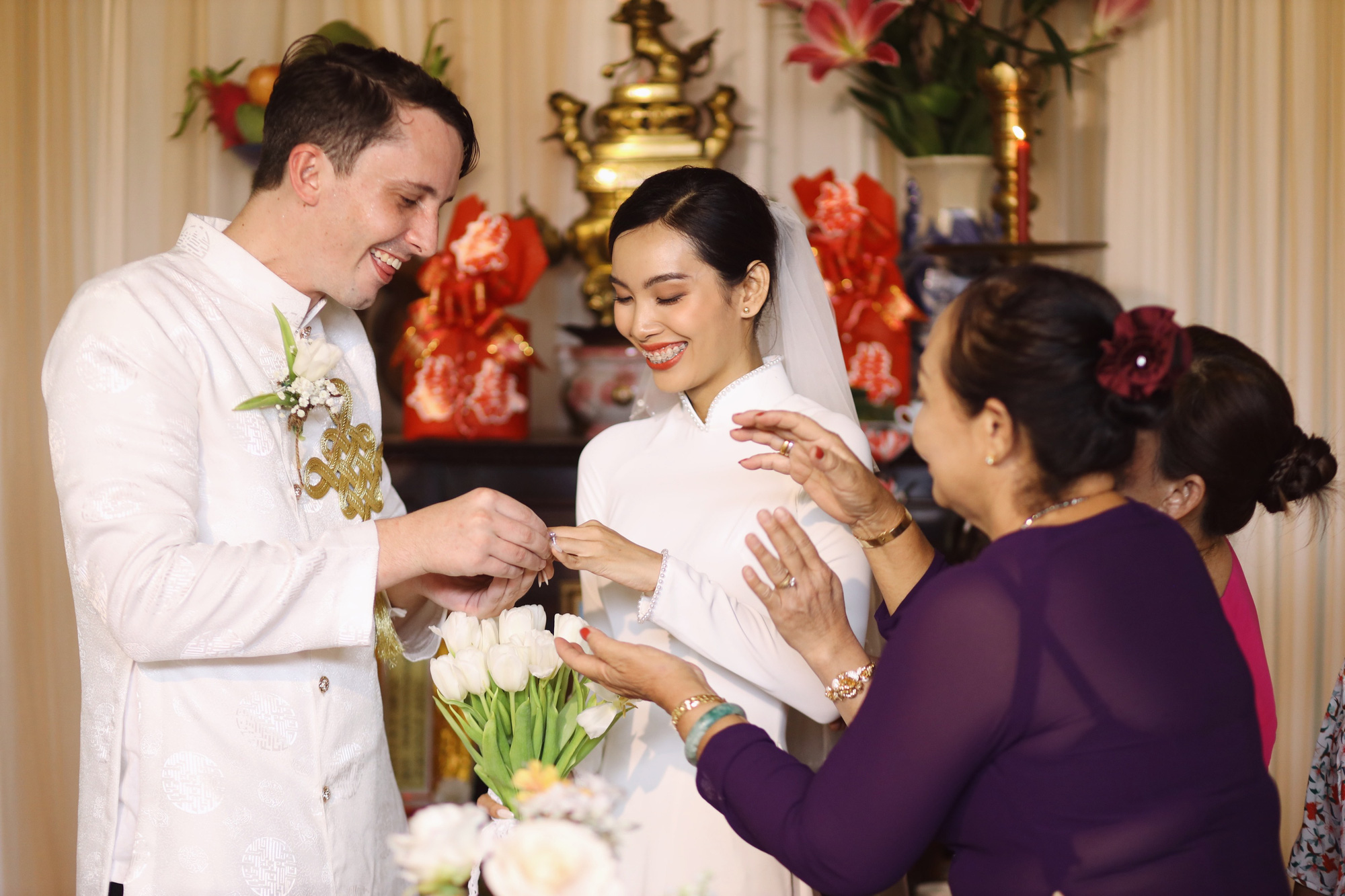
A foreigner’s attempt to speak Vietnamese, often characterized by challenging tones and unfamiliar phonetics, demonstrates a commendable effort to bridge cultural gaps and connect with the local community.
NOTE: TO UNVEIL THE SECRETS OF ARTISTIC CULTURE OF VIETNAM, PLEASE CLICK HERE
III. “Speaking” Without Words: The Power of Non-Verbal Communication
In Vietnamese culture, sometimes what is left unsaid carries more weight than a thousand words. Non-verbal communication plays a vital role in conveying emotions, attitudes, and intentions:
Body Language: A nod for agreement, a shake of the head for refusal, a loving gaze, or a furrowed brow of anger all transmit clear messages. Hand gestures, posture, and even standing or sitting positions can reveal much about one’s mood and attitude. For example, crossed arms might be interpreted as a defensive or unapproachable stance.
Proxemics (Personal Space): The arrangement of sitting or standing positions between communicators is also part of the message. A close distance often signifies intimacy and trust, while a greater distance might indicate respect for social status or formality. This distance can vary by region and relationship.
Communication Through Silence: In some situations, silence is not an empty space but a subtle form of communication. Silence can convey agreement, respect, contemplation, or even indirect displeasure. Understanding the meaning of silence is a crucial skill when communicating with Vietnamese people.
NOTE: TO UNLOCK THE MAGICS OF FESTIVALS & TRADITIONS IN VIETNAM, PLEASE CLICK HERE
IV.The Vietnamese Psyche Through Communication Styles
Vietnamese communication culture bears the strong characteristics of an East Asian society, emphasizing harmony, respect, and tact:
Hierarchy and Forms of Address: This is a core element. Forms of address (anh, chị, cô, chú, bác, ông, bà – brother, sister, aunt, uncle, grand-aunt/uncle, grandfather, grandmother) not only indicate family relationships but also reflect social status and respect. The use of honorifics (dạ, thưa, ạ – yes, respectfully; to address respectfully) is mandatory when speaking to elders or those in higher positions.
Culture of “Ý Tứ” (Subtlety), “Ý Nhị” (Delicacy), and Indirectness: Vietnamese people often do not express their opinions directly, especially when it involves refusal or criticism. They tend to use euphemisms, beat around the bush, or hint to allow the listener to understand on their own. This stems from a desire to save face for both themselves and the other party, avoiding direct offense or conflict.
Proverbs, Folk Sayings, and Folk Songs: These are invaluable treasures widely used in daily communication. They not only make speech more lively and vivid but also convey life lessons, experiences, or express viewpoints deeply and concisely. For example: “Ăn khoai nói chuyện khoai, ăn trầu nói chuyện trầu” (Speak about relevant topics, at the right time and place).
NOTE: GET TO KNOW MORE ABOUT ALL THE ETHNIC GROUPS IN VIETNAM, PLEASE CLICK HERE
V. Bridging Understanding: Intercultural Communication
In an increasingly open society, understanding intercultural communication is key to avoiding misunderstandings:
Challenges: Differences in language, customs, perceptions of time and space, or even expressions of emotion can lead to awkward situations. For example, a foreigner’s directness might be misinterpreted as rudeness by Vietnamese people accustomed to indirect communication.
Opportunities: Grasping the communication characteristics of various ethnic groups and between Vietnamese people and foreigners will help us build better relationships. This applies not only in professional settings but also in daily life. Learning about and respecting differences is the foundation for effective and lasting communication.
Vietnam, with its linguistic diversity and rich communication culture, truly is an open book waiting to be explored. Understanding these aspects not only deepens our love and pride for our national identity but also serves as a key to connecting and building strong relationships in an increasingly flat world.